PAN AM INVENTED IT ALL: FLIGHT ATTENDANTSLately I've been reading a lot of Pan Am memoirs. Most of the more in-depth accounts are from the later years - about Pan Am's decline. One of these days I'm going to get around to a post about Pan Am's slide into obscurity. As I've read more and more, I've started to get a feeling for what happened. The details are many and complex, but they can be condensed down to a couple of things: the world changed, and there was no replacement for Juan Trippe.
But many of the memoirs I've been reading were written by stewardesses. I titled this post "Flight Attendants" to cover the whole history of Pan Am, but most of the good history has been written by stews.
Originally Pan Am's flight attendants were all male stewards. Although I regularly say "Pan Am Invented It All", that isn't true about female flight attendants. I believe United was the first to fly with female cabin crew in the
1930s.
Specifically, Boeing Air Transport, one of the predecessors of United Airlines, first hired a Registered Nurse named Ellen Church to fly on domestic flights in 1930. Miss Church had wanted to be a pilot, but Steve Stimpson, the chief pilot at Boeing's fledgling airline, saw a need for a well-qualified cabin attendant to ensure passenger safety and comfort, back in the days when airline passengers were a superfluous addition, often sitting on sacks of mail (except at Pan Am, of course, where exceptional passenger luxury was already standard).
Following Boeing's (soon to be United's) lead, the other domestic airlines began hiring nurses to see to passenger comfort in the main cabin.
The job of flight attendant was always an elite, competitive position. In the 1930s, newly-termed "stewardesses" had to be Registered Nurses, very attractive, personable, quick-thinking, physically fit, and adventurous.
The training at all the major domestic airlines was rigorous, and the stresses of flying the primitive aircraft of the time were considerable. The stewardesses of the 1930s, however, were legendary for their poise, charm, and
professionalism, and had a huge impact in making flying - dangerous at the best of times in those days - comfortable and safe for the general public.
But not at Pan Am.
In the flying boat era, Pan Am considered aircrew duties to be too important and demanding for women, and did not allow female aircrew at all.
Pan Am stewards in the 1930s had generally been the top of their profession in the Merchant Marine. When other airlines were strapping passengers on top of sacks of mail, Pan Am was flying Consolidated Commodores and Sikorsky S-40s, which were more opulent, although rather less spacious, than the most luxurious
ocean liners of the day.
Becoming a steward with Pan Am meant having years of experience with a major shipping line, then completing Andre Priester's exhaustive training programme in operation of the big flying boats. Originally the stewards were responsible for service only to the rest of the crew - there were no passengers, only mail. Once airborne, the whole crew would change into pajamas to be comfortable on the long overwater flights, then shower, shave, and change back into their Navy-style dress blue uniforms to deplane at their exotic destinations looking like magazine cover models, which, in those days, they often were. (In a charming bit of tradition preserved, I understand the long-haul freight pilots - Fed Ex, DHL, Atlas, etc. - do the same thing today - except for the cover model part, of course.)
Pan Am's stewards were preparing elaborate inflight service on multi-day international flights when the domestic airlines were hiring nurses to help passengers cope with the rigors of flying on aircraft that didn't even have heated cabins. In many ways, the roles of the domestic stewardesses vs. Pan Am's cabin stewards were apples and oranges - and the stewardesses had the much tougher, although far less glamourous, jobs.
This was the status quo until the end of World War II. I believe the term "flight attendant" came about during the war, when the luxuries disappeared from most airline flights, including especially Pan Am, where most of the crews were commissioned into the Navy, but the military needed an appropriate term for the people who were responsible for safety and order in the cabin.
At the end of the war, it was clear things were changing in many ways. The flying boats were gone, replaced by much faster and more efficient land planes that took advantage of all those nice big runways built by the military during the war.
Pan Am changed with the times, buying large numbers of DC-4s (later DC-6's and -7s), Lockheed Constellations, and Boeing 377s Stratocruisers. At the same time they began to hire their first female flight attendants, beginning a wonderfully exciting tradition.
Most of my observations about Pan Am's stewardesses come from Aimee Bratt, who wrote a wonderful memoir called "Glamour and Turbulence: I remember Pan Am, 1966-1991". Her book covers the end of the era, as do most of the more in-depth accounts. Most of the accounts from the early period are much more brief - just snapshots or anecdotes. But Ms. Bratt's book is a classic.
Aimee Bratt was (is) basically a Swedish supermodel, who speaks half a dozen languages, grew up as the globe-trotting daughter of a diplomat, and didn't really have to do anything if she didn't want to. But because she could do anything, she wanted to be a Pan Am stewardess.
And she is about representative of the girls who got to fly with Pan Am.
Pan Am's cabin crew went from being all male in 1945 to all female by the early 1950s. But while international air travel had become more routine and less a matter of exploration, it had also greatly increased in magnitude, becoming a significant part of the world economy and society, as opposed to mainly a way to move mail.
Pan Am's stewardesses were the public face of the institution - the part of the "World's Most Experienced Airline" that passengers actually interacted with.
And the standards were incredibly high. I don't think much of anyone today can conceive of how high those standards were. Most of the major airlines had pretty strict standards for aircrew, but Pan Am's, of course, were by far the most intense.
Just to get in the door, in addition to advanced education, worldliness, language skills, and social connections, aspiring Pan Am stews had to meet strict height-weight standards, and be very obviously attractive. They were
literally the most desirable women anywhere.
Once hired, Pan Am stews were subjected to random inspections - down to their underwear, and including "weigh-ins". A pound overweight and you could be on probation. Miss another weigh-in and you could be fired. Can you imagine an airline in 2005 trying to impose those kind of standards? (Or any kind of standards, as far as I can tell.) The uniforms were ultra-stylish, but not ultra-comfortable or practical, and Pan Am set standards for everything - hairstyles, makeup, fingernails, even girdles.
Aimee Bratt talks about how she was kept in suspense about whether she would be hired by Pan Am for months, only to suddenly be given 24 hours to report for training in Miami - and she was in Teheran. Pan Am was more demanding than the military - and they could afford to be, because the competition to be a part of the legendary "service" was intense. If Aimee didn't show up on time, she would be summarily dropped - because there were 10 more girls like her competing for the slot.
Once through training, the pressure only became more intense, but the rewards were equally as great. Aimee talks about making multi-course meals from scratch in the tiny galleys on the 707. 707s had nearly 200 passengers and were substantially smaller on the inside than the Boeing 314, which normally had
about 40. Pan Am stewardesses routinely wheeled a freshly-prepared prime rib down the aisle, and carved it to order at the passenger's seat. Unlike air travel today, almost all the food (in first and clipper classes, at least) was made (almost) from scratch onboard. Just as the stewardesses of the 1930s at United and American had tougher jobs than Pan Am's stewards, the stewardesses of the 1950s and 1960s had almost superhumanly difficult responsibilities.
But the opportunities were extraordinary as well. Pan Am aircrews were treated like royalty in most parts of the world, and the glamour of flying for Pan Am has probably never been equaled. Pan Am crews regularly circled the globe, with layovers at places that don't even have usable runways in 2005. A little bit of this mystique was captured in the recent Steven Spielberg/Tom Hanks movie "Catch Me If You Can", where real-life con man Frank Abignale posed as a Pan Am pilot. But the movie didn't begin to capture what it was really like for Pan Am
crews flying to remote corners of the globe.
Now it's all gone. Aimee Bratt, when she wrote her memoir about Pan Am in 1996, was still flying with Delta, but the changes in the world and the airlines come through loud and clear in her writing. She herself reflects how things have changed and how the fun and romance has gone out of air travel, and seems to have become far less tolerant of any of it - the airlines, the passengers, the stress of travel - after 30 years than she was in the heyday of Pan Am. If you have been on an airline recently, you know extremely exemplary she is of the
flight attendants in 2005. I'm not sure when I last encountered a flight attendant who wouldn't have been fired on the spot at Pan Am.
Sometimes I look at old Pan Am route maps and schedules and reflect on what so many of those old Pan Am destinations are like now. Beirut, Teheran, Monrovia, Leopoldville, Baghdad, Saigon, Havana, Wake Island - places you simply can't go to, or don't want to - but Pan Am flew there every day for decades. There's nothing like it, and almost certainly there never will be again.posted Sunday, 15 May 2005
Monday, April 4, 2011
Pan Am!

Wednesday, March 16, 2011
Japan
The black building you see swaying in this video from Tokyo's Shinjuku ward was the one I worked in while I was there.
I'm thoroughly disgusted with Rush Limbaugh, Glenn Beck, Gilbert Gottfried and their ilk. Beck especially deserves our opprobrium. That being said, Ishihara Shintaro, governor of Tokyo, repeated some similar tripe, so I guess you could say that my patience with doomsaying religious nutcases is pretty thin right now.
At this moment, I'm feeling pretty tribal, and the Japanese are my people. I lived among them, and for the most part they were more welcoming to me as guest than the Yankees I currently live among, who are ostensibly my fellow nationals. If this was God's retribution for anything we humans may have done, then God has pretty piss poor aim. It's not retribution for anything, though, and Glenn Beck can go fuck himself.
I'm a bit disappointed in America at our relatively paltry charitable response. Is it that we expect the Japanese to be capable of taking care of themselves? Why was the giving to Haiti so much greater? Is it racism? Let me explain that last one, before someone points out that Haitians are black: I suspect one of the reasons donations to Haiti were so great was white guilt over a combination of slavery and US interventions there. But Haiti is still obviously inferior to the US in many ways, from education to cooperative culture. It's easy, in a limousine liberal sort of way, to deplore racism when we are simultaneously making ourselves feel secretly superior by handing out alms. We never seriously expect those people in Haiti to be our equals, no matter what platitudes we may mouth in public. On the other hand, the Japanese are already our equals or betters on most fronts. Compare the lack of looting in Japan with New Orleans, for example, and I Goddamn dare you, or Beck or any other fuckhead to claim that theirs is a culture that needed smiting.
What is even more troubling is that the situation may get worse, and I'm not even speaking of the impending nuclear disaster. The last time a quake this big hit Japan (in the same general region) was in October 1707. Two months later, Mt. Fuji erupted. Fujiyama has already experienced a 6.0 tremblor in the wake of the Sendai quake. This was not an aftershock - the fault line under Fuji is distinct from the one in the ocean near Sendai.
My heart, and my money, are with Japan. I hope yours are, too.
Monday, February 28, 2011
Computer generated Qaddafi-rant
Real Qaddafi rants:
"You in Zawiyah turn to Bin Laden," he said. "They give you drugs."
"I cannot recognise either the Palestinian state or the Israeli state. The Palestinians are idiots and the Israelis are idiots. "
"A woman has the right to run for election whether she's male or female!"
"Were it not for electricity, we would have to watch television in the dark!"
"I am not such a dictator that I would shut down Facebook. I would only imprison anyone who logs in!"
"All the terrorists in the house: put your hands up!" (to the UN)
“We are content and happy if Obama can stay forever as the president of America!” (the same UN speech)
Who said it: Qaddafi or Charlie Sheen?:
"[My enemies] are at home or they are abroad...comfortable, and having fun!"
I will miss this guy when he is gone. He is too much fun! (Qaddafi, not Charlie Sheen)
Monday, January 10, 2011
Appropriate?
The MSM has delighted in portraying the wacko shooter in Arizona as a "right wing fanatic". I'm watching Katie Couric making that case on CBS news as we speak. She just fed a loaded question to the Sheriff in Tucson, who just said that the 2nd Amendment is the "height of insanity"... that nugget of wisdom led directly into a CBS "hit piece" on the right to bear arms, suggesting that a CBS-style gun ban would have prevented this tragedy.
I went out to the barn to check on the horses and came back inside and, 10 minutes later, CBS was _still_ suggesting that the 2nd Amendment and the Tea Party movement was responsible for the shooter in Arizona, who by most accounts was a seriously crazy pot-head nihilist, with no coherent political affiliations at all.
The Arizona shooter reportedly asked Congresswoman Giffords "What is government if words have no meaning?". Giffords was reportedly bewildered by the (bewildering) question and Loughner became angry from her inadequately-sympathetic response.
The guy had (and still has) several You-Tube videos online that are completely nonsensical: "Every human who is mentally capable is always able to be the treasurer of their new currency" Huh? And it gets weirder from there.
He goes on: "Secondly, my hope - is for you to be literate! If you're literate in English grammar, then you comprehend English grammar." Uh-huh... "If I have my civil rights, then this message wouldn't have happen." So much for literacy...
He reportedly had a fuzzy-headed thing about grammar, but the question about government and words having no meaning was interesting.
Ultimately politics is about communication, the expression of ideas. Ideas can be powerful, whether or not they are connected to reality or evidence. Smart political operatives have long understood this. Lyndon Johnson famously sought to accuse an opponent of copulating with livestock. He, and everyone else, knew it was a scurrilous libel - but he also knew it would work.
So the problem is not that words have no meaning, but that they do - they have more meaning than they deserve, so much so that tangible, real evidence pales next to their semantic and psychological potency. Another way to express this is the axiom that "perception is reality". In other words, truth doesn't matter - what matters is what people believe.
And people can be counted on to be reactionary and have short attention spans - what you tell them now will often have more impact than what they knew to be true yesterday.
I think the left wing understands this all to well - which explains what they report on CBS news. It almost always works, even as the people, at a deeper level become even more disaffected and distrustful of almost all public voices. Disapproval of Congress currently stands at 74%. I don't know exactly how this compares with opinions of Congress in other times in history, but its the worst I can remember.
What this seems to mean is that the cacaphony of demagogery works: in a short term sense it confuses the people about what to believe, causing them to become somewhat disoriented and disconnected from their core understanding and belief. In the longer term it causes deep disaffection, disconnection, and cynicism about public institutions. If you're an anarchist or a nihilist (like the Arizona shooter may have been, to the extent he was lucid at all), this can be just what you want. If your goal is the destruction of traditional public institutions - in our case the institutions of Western civilization - then it's a pretty good strategy.
The basic question is whether loss of legitimacy of public institutions is a good thing. If you think it is, you probably would qualify as a revolutionary. The trouble with revolutions, though, is the revolutionaries seldom know where they will lead.
In our own case, the American Revolution was profoundly positive, creating the worlds oldest, greatest, and strongest democracy. Most folks (although these days maybe that's a stretch) would probably agree it was positive because it was strongly grounded in traditional western Judeo-Christian ethics. Most other revolutions have not worked out so well.
I reflect on the fact that today I am hesitant and wary about expressing my political opinions - even though those opinions are almost identical to the ones expressed by Thomas Jefferson. I write this blog (semi) anonymously and am much more wary about what I say in attributable fora. It makes me wonder where we are in terms of the political climate in the western world, and reflect that my opinions, which I'm wary to express, are pretty much the _exact same_ as the ones that got the founding fathers in trouble with the British 235 years ago.
In closing, I'll say this: if we are not willing to defend liberty - freedom from oppression, freedom of expression, freedom to pursue happiness - we won't have much of it for much longer, and none of it pretty soon.
We're lucky: we have a constitutionally-established republic that accords special status to individual freedom and liberty. Unlike the founding fathers, we don't need a revolution to preserve it. But if we do not think about, and defend, what we believe in, rather than about the demogogery and rhetoric telling us things we know are not true, we could lose it. When it's gone we'll understand we did the wrong things.
Monday, December 13, 2010
Wooly Worms
The wider or thicker the brown band (which is usually in the middle), the milder the winter is expected to be.
Last winter the wooly worms were solid black, predicting a cold, snowy winter - which is exactly what we got.
This year the reports are a little more mixed, with a little more brown being seen on the wooly worms - although the reports are mixed. The official Wooly Worm web site, hosted by the Wooly Worm Festival held every October in Banner Elk, NC, has a more detailed and fine-grained worm-based forecast. It says:
Checking the Farmer's Almanac, we find a similar prediction:
Based on the width and order of the caterpillar's black and brown stripes, Jack's forecast for the coming winter (starting with the winter solstice on December 21) says there will be cold and snow through the holidays and on into late January. There will be a bit of a warming trend in the last week of January and first week of February with a chance for ice. February will continue cold, becoming extremely cold in March. The weeks leading to the spring equinox on March 20 will see the winter close with lots of snow.
Perhaps the Farmer's Almanac uses wooly worms? I certainly wouldn't be surprised.Old Man Winter doesn’t want to give up his frigid hold just yet, but his hold will mostly be in the middle of the country.
According to the 2010 Farmers’ Almanac, this winter will see more days of shivery conditions: a winter during which temperatures will average below normal for about three-quarters of the nation.
A large area of numbingly cold temperatures will predominate from roughly east of the Continental Divide to west of the Appalachians (see map). The coldest temperatures will be over the northern Great Lakes and the Upper Peninsula of Michigan. But acting almost like the bread of a sandwich, to this swath of unseasonable cold will be two regions with temperatures that will average closer to normal—the West Coast and the East Coast.
Another source says the wooly worms in West Virginia are all black. Perhaps the wooly worms are regionally precise? I have also heard that some all black ones were seen around here, as were some with a thick brown middle band, which indicates a warm spell in the middle of winter.
Comparing with scientific sources, the UAH global temperature anomaly shows a global average slightly cooler than last year for the last few days, but pretty close to the average for the last several years. This gets us back to the basic issue that local climate and global climate can be very different things, and we don't necessarily know exactly what that means. Last winter was one of the coldest in the modern record in the US, Europe, and China, but was warmer than average globally, because there were large areas in the higher latitudes (Northern Canada, South Pacific) that were significantly warmer than average.
So far it feels colder than usual around here and it isn't even winter yet. The forecast for tonight is 15 degrees F. Tomorrow it is supposed to be 13 deg. F. In many recent years past we have had shirtsleeves weather in December - but not in the last 3 or 4 years. Apparently it isn't just me: there have been a record number of new weather records this month, mainly for low temperatures and snowfall: check out this chart.
So what can we expect for the rest of the winter? (Actually, "the winter", since it is still fall.) According to the wooly worms it will continue frigid until at least late January.
Sunday, December 12, 2010
Very Large Globes
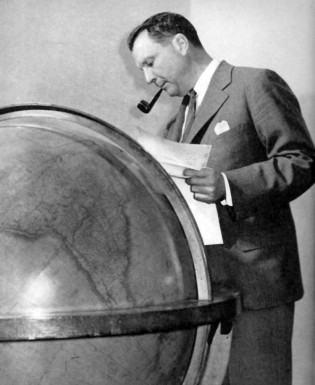
To review, Juan Trippe, when he was the head of Pan Am, had a very large antique globe in his office in the Chrysler Building. He used the globe and bits of string to plan out Pan Am's pioneering routes around the world.
That globe is now in the Smithsonian Institution, where I saw and reported on it in 2008. Close examination revealed it to be a "Malby's Terrestrial Globe", which was not terribly significant to me at the time, but probably should have been:
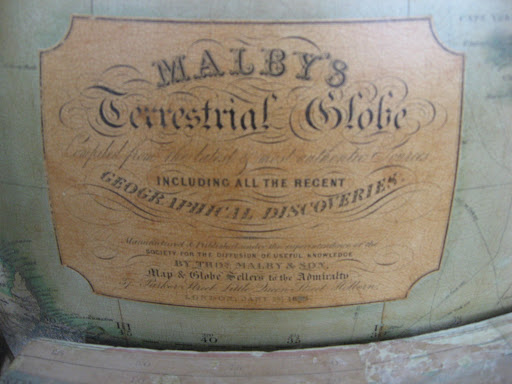
Markings on the globe indicate it was manufactured in "18*4" - the third digit had been obfuscated by wear. I theorized at the time that it was manufactured in 1884 or 1894, but that was incorrect.
Thomas Malby was a globe and chart maker in London who first estabilished his business in 1810. In 1849, he re-issued the 36" 1825 Addison globe "for the Great Exhibition", which was held in 1851 (in partnership with the Society for the Diffusion of Useful Knowledge, or SDUK). Reportedly Malby sold these globes until 1862, after which they were sold by James Wyld, another famous 19th century London globe maker.
There are quite a few Malby globes to be found around the world, but the giant 36" models are very rare, and very valuable. According to the University of Utah, who have two of them, there are only eight left in the world (three in the US and three in the UK, in addition to the two at Utah, according to them). I'm not sure this is correct.
Yesterday I was at the Biltmore House in Asheville, North Carolina, and was very surprised to see a 36" Malby globe in the library there. Perhaps more amazingly, a 36" Malby globe was recently sold at auction in New York - for $103,700. Including the Juan Trippe globe, that's three right there. Here are two more - although they are listed as "by James Wyld", they date from 1860 and I believe Wyld globes were actually made by, and labeled, Malby in 1860.
So Juan Trippe's globe would appear to probably be dated 1854, which is when Malby's big globes were at their most popular. (Here's an advertisement for them from 1850.) While there are probably more than 8 of them still in existence, they are still incredibly rare and valuable.
Globes are not cheap under any hardly any circumstances. The closest modern analogue to the large Malby globe is the 32" Replogle Diplomat - which runs around $8000 new. Someday when I have $8k lying around I'm going to get one so I can play Juan Trippe at home...
And Malby's? They're still in business in London, now known as the London Name Plate Manufacturing Co., Ltd. They no longer make globes (as far as I can tell) but the company is run by the 7th generation of the Malby family. Cool... Now if we could just get them to make more 36" globes!
Monday, November 1, 2010
JFK
I've never had a big opinion about JFK conspiracy theories although I tended to believe the basic premise that Lee Harvey Oswald did in fact shoot JFK.
Whether he was part of a larger conspiracy, whether well organized or not, I've been pretty agnostic. There are a lot of facts that seem to point to a conspiracy: Oswald's defection to and redefection from the Soviet Union, his relationship with Cuban radicals, the trip to Mexico City, etc etc., not to mention his own subsequent assassination by Jack Ruby.
At Dealey Plaza I just wanted to check out the geometry of Oswald's shot and see if it made sense to me. There have been many, many conspiracists who said the shot was "impossible" and I wanted to see for myself.
My impression was that the shot was far from impossible, although Oswald, who was only a mediocre shot in the Marine Corps, was somewhat lucky with the perfect headshot.
Similarly there has been a great deal of controversy about the Zapruder film, alleging it proved the shot could not have come from the 6th floor of the Texas Book Depository. After standing in Oswald's perch on the 6th floor, looking at the "X" on the pavement where the fatal shot hit JFK, and standing on the spot where Zapruder made the film, it looked like it all made sense to me. The Zapruder film shows an explosive exit wound that looked to me to correlate with the trajectory from the 6th floor of the depository. The earlier frames also seemed to be consistent with the earlier shot from the same location, which hit JFK in the back and also hit Governor Connally.
While lurking on the grassy knoll, I met a very interesting man who claimed to be an eyewitness to the assassination, 13 years old at the time, who was across and up the street from where Zapruder took the film. He said he was sure he saw a shooter on the grassy knoll, that a part of Kennedy's skull was blown backwards, behind the car and across the street, and that nearly all the witnesses at the time believed the shooter was on the grassy knoll. He then went on to relate many of the more wild and unbelievable facets of the conspiracy theory, such as that Oswald, Ruby, J.D. Tippitt, etc, all knew each other in Dallas before 22 November 1963. I have no idea whether anything he said was true, but he told a good story.
So my individual objective observations seemed to support, to me anyway, the basic premise of the assassination: that Oswald, on the 6th floor of the school book depository, fired three shots in about 6 seconds and hit Kennedy twice, killing him instantly with the (probable) third shot.
But like everything with the Kennedy Assassination, there are an awful lot of puzzling bits of evidence. To me the poor ballistics analysis has always been problematic. Oswald probably fired three shots, but where did the third (or most likely second) shot go? Something hit witness James Tague, but I've never seen a good analysis of how that bullet got to where it was. (Fascinatingly (to me), Tague, like practically every witness who has made statements that I've heard of, reports facts contrary to the Warren Commission report and may believe in a conspiracy involving a shooter on the grassy knoll. I have no idea if that means anything other than they all see financial gain in promoting a conspiracy.)
There are just so many strange facts about the case - like why did Oswald visit the local FBI office and threaten FBI agent James Hosty, warning Hosty to stay away from his wife? And why was he not arrested for making the threats? And why did the FBI destroy the written, threatening note that Oswald left for Hosty?
Who was the strange man who presented Secret Service credentials to Dallas Police Officer Joe Smith in the parking lot behind the grassy knoll in the seconds after the assassination? No official authority has ever provided an explanation for Officer Smith's testimony, as there were no known Secret Service agents on the grassy knoll, and especially none dressed in casual clothes, as Smith reported.
What about the other strange bullets and cartridges found near Dealey Plaza? Not that I necessarily believe any of them have anything to do with the assassination, but it is strange.
Ultimately, I have to stick with Occam's Razor. If there was a massive conspiracy, it would have had to have been unimaginably massive, and it probably would have come out by now. If there were other shooters, they were way closer to JFK than Oswald and apparently didn't hit anything - and there would have had to have been a massive coverup to conceal the evidence of their presence.
A lot of weird stuff went on - destroyed evidence, coercion of witnesses, botched investigations, etc. - but I think the explanation for it all is probably typical government incompetence and arrogance, not an organized conspiracy. Finding the magic bullet on Connally's stretcher was particularly strange.
I think if there was a conspiracy, it probably involved Oswald as the shooter with "guilty knowledge" about his plans and general strangeness among the various government agencies who had been interested in him before November 22nd. The FBI, particularly, behaved very suspiciously, but then again J. Edgar Hoover was in charge and they behaved oddly most of the time.
But ultimately I'm agnostic. I wasn't there, and it's hard to tell what happened years later. Like most stuff of this ilk, I think the discussion says more about us today than about what happened then.

