It seems to be music week in the UCF, and since I have not been posting recently, but this has been sitting in the queue unfinished, I thought I should publish it.
I live in a household of three languages, only two of which I speak. What Hokkien gets spoken (between my wife, MIL, SIL, various Aunts and my wife's best friend in town) goes entirely over my head. But, like the man who was turned into a newt, my Mandarin is getting better. Largely through song.
I'm constantly exposed to stuff via my wife that's actually useful in my day job because I work in Asia a good deal. As a smarter than average High School and college kid, I used to despise pop culture, but as an older and wiser adult I see its value. Having a social connection to people, an instant one, breaks down barriers. And one activity every decent adult should be engaged in throughout their lives is in breaking down barriers.
So I've gone from rolling my eyes at my wife's taste for 70s and 80s mandopop to actually appreciating it. And using it. Much as it pains me to admit it, I can actually sing several Chinese songs as karaoke.
But being much more historically oriented than my wife, now and then I find some nuggets she overlooks being in the culture and accepting things, rather than looking at them with fresh eyes as I do.
Many melodies in mandopop are recycled. Weirdly to Westerners, some of those recycled melodies are hymns brought to China by missionaries. One of my wife's favorite song's melody is largely based on "There is a Fountain Filled with Blood" and another one - and I don't know why Disney never sued them - is pretty much entirely the theme song from "Davy Crockett", at a slower tempo. I kid you not.
But there are other influences, too. Despite the lingering hatreds from 50 years ago, Japanese culture pervades the East. Their aesthetic in clothes and music, especially. We were just back in Taiwan for Chinese New Year. My wife warned me not to wear black. Chinese people wear bright colors at New Years, she says. Well, they did 30 years ago when she left. Today? Not so much. I like black. I wore it. I fit in better than she did. She was the only one in a lot of photos wearing a red jacket. The blacks, grays, and muted browns of Tokyo's streets also adorn the figures on the streets of Taipei, Taichung and Tainan.
But the Japanese influence music, too. Not just the infusion of J-Pop since the 80s. This influence goes back a long way, all the way back to the origins of mandopop in Shanghai.
One of my wife's favorite singers is Tsai Chin (蔡琴), who has a lot of Chinese standards in her repertoire. This one, 意難忘 (Unforgettable Feeling) is one of her favorites:
藍色的街燈,
Indigo street lights
明滅在街頭獨自對窗,
Blink on the street corner through my lonely window,
凝望月色,
My eyes focus on the moonlight
星星在閃耀,
The stars are sparkling and my tears are flowing
我在流淚,
My tears are flowing
我在流淚,
My tears are flowing
沒人知道我
No one knows who I am,
啊 ~~ 啊 ~~
Oh--, Oh--
誰在唱啊,
Who is singing "Oh"?
遠處輕輕傳來想念你的,
A distant place gently brings on longing for you
想念你的,
Longing for you
我愛唱的那一首歌。
I love to sing that song
你我的回憶,
You are my reverie
該是兩相同
The two of us should be together
咫尺天涯,
We're close by each other but poles apart.
為何不見,
Why don't we see
此身已破碎
This life has ended in tatters
我在流淚,
My tears are flowing
我在流淚,
My tears are flowing
沒人知道我
No one knows who I am
啊~~ 啊~~
Oh-- Oh--
It was originally recorded in Chinese by the early-60s mandopop star Mei Dai (美黛).
It's worth noting that when Mei Dai recorded her version, mandopop had been branded "pornographic" by the prudes running the Cultural Revolution on the Mainland. The center of Chinese music had shifted from Shanghai to Taipei and Hong Kong by the 50s, a blow from which Mainland music has yet to fully recover.
But I was looking for things related to this kind of music the other day and I stumbled upon the origins of this song. It's not Chinese at all.
It's Japanese.
The original title is "Tokyo Serenade" (東京夜曲), and it was originally recorded by Li Jichun in 1949:
青いランプに夜は更けて
The night passes under the blue lamp
カーテン引く手のやるせなさ
A hand pulls the curtain back
泣けば泪の星空を
Shedding tears to the starry sky
あ~~
Ah--
流れくるくる
A stream swirls
あの歌は
That song is for
誰が歌うか
Whomever will sing
東京セレナーデ
Tokyo Serenade
白い毛糸の編みかけの
I start to knit with white wool
あなたのジャケツに 頬寄せて
I gather your jacket to my cheek
移す想いの紅のあと
My thoughts follow the crimson to dark
あああ
Ah--
消えてくれるないつまでも
They vanish to dark forever
ひとり聞いてる
Alone I listen to the
東京セレナーデ
Tokyo serenade
二人一つの思い出の
Two people each reminisce
匂いは薔薇よ小田急よ
Of the fragrance of the Rose in Odakyu
やさしいソファーに 燃える身を
On the simple couch my body burns
あああ
Ah---
投げて夢見る 夢の果て
Throw away my dreams
甘い吐息か
With a sweet sigh?
東京セレナーデ
Tokyo Serenade
The song was recorded in Tokyo, as the Nationalists were not really disposed to promote a lot of Japanese culture in the wake of losing the Revolution.
So what was Li doing in Japan? She had appeared in several Japanese propaganda films in the 40s, and was tried for treason by the KMT in 1946. Before she could be sentenced, it became apparent to her fans (and the KMT) that Li was not as Chinese as her stage name might indicate.
Her real name was Yamaguchi Yoshiko ((山口 淑子 - I'm using the Asian convention of last name first for real names), and she was a Japanese born to Japanese settlers in Manchuria, picking up a surname from one of her father's Chinese blood brothers. Classically trained by an Italian soprano married to a White Russian living in China (a common state of affairs in the Warlord Period), she became quite famous in the Shanghai singing scene. You can get a taste of the singing world of Old Shanghai, with Western opera, Jazz, and Beijing opera styles all blended together, in this old recording of Yue Lai Shang (夜來香), a Chinese standard first recorded by Miss. Yamaguchi (also covered by Mei Dai and Tsai Chin, among many others):
After returning to Japan she restarted her singing career, went to America to start in a few B movies, returned to Japan, hosted a TV show and then wound up as a member of parliament. She's still around, too, one of the last living witnesses to the flowering of modern Chinese pop culture in Old Shanghai. She has always felt a little bit uneasy around Chinese since the war, and never got over her guilt for the propaganda she filmed.
But the Chinese still love her music. I won't be so trite as to say music (or love) conquers all (despite most 1960s and 70s Chinese pop singers being able to sing in Japanese, the Chinese certainly didn't copy the lyrics to this song to include Tokyo as the setting...) , but it sure does go a long way to breaking down barriers.
Friday, March 5, 2010

Tuesday, March 2, 2010
Corporations in Space
Leonardo da Vinci is a one of a series of case studies anyone who wonders why we don’t have space travel right now should consider. Because Leonardo da Vinci was an idiot. Well not really. More like an idiot savant. Unnecessarily ahead of his time. What I mean by that last crack is that he pretty much epitomizes the American criticism of people who live a life almost entirely of the mind: “if you’re so smart, why ain’t you rich”?
Leonardo once “designed” a helicopter.
There was no motive force in the world that could have turned his invention fast enough to get it off the ground.
If Leonardo had used his considerable talent to think about pumps instead of flying machines, I have little doubt that he was smart enough to have produced a working steam engine. Many, many years before the first one was actually put to use in a mine. He would probably have had to solve some metallurgical problems along the way, but he would have found a ready buyer in mining operators even in his day. He could have become completely free of rich patrons for his art had he made that engine. That steam engine would not have powered his helicopter either, but it would have sped the invention of an actual helicopter by over a century.
But Leonardo had too much of an artistic temperament to think about mundane things like mines and metallurgy (beyond sculpture). So he produced pretty pictures of helicopters that never did anyone any good at all.
Infrastructure matters.
Going on to a somewhat more relevant and modern example, computer networks could have been invented and linked back in the 50s. But why? The computers they would have linked could not do much, the telecom links would have been unreliable with huge data losses, and the maintenance costs of the infrastructure would have been staggering.
Computers could have been linked in the 60s, and in fact the Space Program made some tentative steps in that direction, because of the present need of the program and because the money was there for upkeep. ARPANET was conceived in 1962 or so. But a civilian version would have charged too much to be of any commercial use because of the paucity of customers. Ditto for the 70s.
ARPANET started to transmit in 1969, and the DoD underwrote the costs. This began to build telecom infrastructure.
The PC market exploded in the late 70s and early 80s and suddenly there was an end-user infrastructure and a growing customer base. Remember the old modems with a 2 cup cradle for an old telephone handset? That led to Compusoft and the rest of the early internet. But without that PC and telecom infrastructure, the internet would have been stillborn. Sure, in some alternate universe a Telecom could have seen it as the wave of the future (ATT? HAH!) and created a network by brute force. But it would have been a commercial failure, and paradoxically, that failure probably would have made capital gunshy and delayed the development of a real and useful Internet by a decade or more.
We would have sent packets into the ether and stranded them there.
Most high technologies need a nutrient-rich environment in which to grow. Infrastructure has to be in place, and the costs have to eat only a small amount of GDP. They can’t be too tricky to maintain, or customers will do without or find a replacement. They can’t suck at public resources too badly. Most ideas never get off the ground, and people are not willing to give up a significant chunk of their standard of living in order to take a risk on something that has a high probability of failure, as most new ideas do. Payoff has to be relatively short term (within a few decades) in order for a business to find that technology profitable.
The costs are too high, the timelines for development too long and risk of failure too great for a business to take a chance on many complex technologies.
Sometimes, the government has to nurture the technology along until it is mature enough for free enterprise to take over. But visionaries in government are few and far between (and seldom in positions of power), so human progress is slower than it otherwise could be.
Space travel is definitely one of these complex technologies I’m talking about.
We, as a human race, achieved it before we were really rich enough to take advantage of it. We pushed the infrastructure hard, but it couldn’t stand the strain over the long haul. We were in a 1950s computing world, and we demanded that Cisco develop fiber-optic links between our vacuum tube monsters. They did, but it cost us an arm and a leg. Even my favorite redneck Country Rock group talked about “too many lives we spent across the ocean, too much money we spent up on the moon”.
We sent our hopes and dreams to the moon and stranded them there.
We were too early. Mankind wasn’t rich enough to afford the moon. I’m not sure it is, even now.
Jim’s essay on space travel is food for thought, and I definitely share his Libertarian-leaning sentiments about commercial space flight.
But I’m not sure we are out of the government-funded cocoon stage for space flight technology, and if we aren’t, it’s as if we’re asking commercial enterprise to build an Internet to connect transistor-based late-1960s UNIVACs. I’m not sure that computer infrastructure would have been big enough to justify the costs. Just as I’m not sure that the space travel customer base is big enough to absorb the development costs. Maybe it is. But if it isn’t, the resulting failure may set us back more than if we let NASA bumble along a bit longer.
I think Jim talks too glibly about the age of sail as an example. Building a sailing vessel, or even a fleet of them, was in no way as resource intensive as building a space program. In the language of business, the barriers to entry were high, but not astronomically (HAH!) so.
Not true for space travel.
Even with the lower barriers to building a wooden ship or two in the Age of Exploration, governments under-wrote a lot of the costs, as one of Jim’s commenters noted.
The first companies out there are going to look like government-sponsored monopolistic rapists, very much like Hudson Bay or East India. Commercial space exploration is not going to be pretty.
I really don’t care about that, though, my major concern is that when people talk about private enterprise, they don’t talk about what, exactly, space is going to provide that isn’t cheaper to get (or get a substitute for) down here. The only business plan I see at the moment is tourism. NASA has not turned up any useful process that creates things in low G environments that people really want down here, and NASA has been trying to find such a technology for decades.
I know, I've been involved in some of those experiments. I could make something nearly as good as the space polymers I was involved with for much less than what it cost to make them on the Shuttle, even with NASA underwriting the transportation costs - bench space was pretty nearly infinite in my lab compared to a cramped Shuttle cargo bay.
But, like Jim, I think space travel is necessary for the survival of the race, and I want my grandkids (at least some of them) off Earth. My genes are selfish that way.
I just don’t have enough information yet to be as happy as he is about the lack of vision in our government. Maybe he’s right. I hope so.
Leonardo once “designed” a helicopter.
There was no motive force in the world that could have turned his invention fast enough to get it off the ground.
If Leonardo had used his considerable talent to think about pumps instead of flying machines, I have little doubt that he was smart enough to have produced a working steam engine. Many, many years before the first one was actually put to use in a mine. He would probably have had to solve some metallurgical problems along the way, but he would have found a ready buyer in mining operators even in his day. He could have become completely free of rich patrons for his art had he made that engine. That steam engine would not have powered his helicopter either, but it would have sped the invention of an actual helicopter by over a century.
But Leonardo had too much of an artistic temperament to think about mundane things like mines and metallurgy (beyond sculpture). So he produced pretty pictures of helicopters that never did anyone any good at all.
Infrastructure matters.
Going on to a somewhat more relevant and modern example, computer networks could have been invented and linked back in the 50s. But why? The computers they would have linked could not do much, the telecom links would have been unreliable with huge data losses, and the maintenance costs of the infrastructure would have been staggering.
Computers could have been linked in the 60s, and in fact the Space Program made some tentative steps in that direction, because of the present need of the program and because the money was there for upkeep. ARPANET was conceived in 1962 or so. But a civilian version would have charged too much to be of any commercial use because of the paucity of customers. Ditto for the 70s.
ARPANET started to transmit in 1969, and the DoD underwrote the costs. This began to build telecom infrastructure.
The PC market exploded in the late 70s and early 80s and suddenly there was an end-user infrastructure and a growing customer base. Remember the old modems with a 2 cup cradle for an old telephone handset? That led to Compusoft and the rest of the early internet. But without that PC and telecom infrastructure, the internet would have been stillborn. Sure, in some alternate universe a Telecom could have seen it as the wave of the future (ATT? HAH!) and created a network by brute force. But it would have been a commercial failure, and paradoxically, that failure probably would have made capital gunshy and delayed the development of a real and useful Internet by a decade or more.
We would have sent packets into the ether and stranded them there.
Most high technologies need a nutrient-rich environment in which to grow. Infrastructure has to be in place, and the costs have to eat only a small amount of GDP. They can’t be too tricky to maintain, or customers will do without or find a replacement. They can’t suck at public resources too badly. Most ideas never get off the ground, and people are not willing to give up a significant chunk of their standard of living in order to take a risk on something that has a high probability of failure, as most new ideas do. Payoff has to be relatively short term (within a few decades) in order for a business to find that technology profitable.
The costs are too high, the timelines for development too long and risk of failure too great for a business to take a chance on many complex technologies.
Sometimes, the government has to nurture the technology along until it is mature enough for free enterprise to take over. But visionaries in government are few and far between (and seldom in positions of power), so human progress is slower than it otherwise could be.
Space travel is definitely one of these complex technologies I’m talking about.
We, as a human race, achieved it before we were really rich enough to take advantage of it. We pushed the infrastructure hard, but it couldn’t stand the strain over the long haul. We were in a 1950s computing world, and we demanded that Cisco develop fiber-optic links between our vacuum tube monsters. They did, but it cost us an arm and a leg. Even my favorite redneck Country Rock group talked about “too many lives we spent across the ocean, too much money we spent up on the moon”.
We sent our hopes and dreams to the moon and stranded them there.
We were too early. Mankind wasn’t rich enough to afford the moon. I’m not sure it is, even now.
Jim’s essay on space travel is food for thought, and I definitely share his Libertarian-leaning sentiments about commercial space flight.
But I’m not sure we are out of the government-funded cocoon stage for space flight technology, and if we aren’t, it’s as if we’re asking commercial enterprise to build an Internet to connect transistor-based late-1960s UNIVACs. I’m not sure that computer infrastructure would have been big enough to justify the costs. Just as I’m not sure that the space travel customer base is big enough to absorb the development costs. Maybe it is. But if it isn’t, the resulting failure may set us back more than if we let NASA bumble along a bit longer.
I think Jim talks too glibly about the age of sail as an example. Building a sailing vessel, or even a fleet of them, was in no way as resource intensive as building a space program. In the language of business, the barriers to entry were high, but not astronomically (HAH!) so.
Not true for space travel.
Even with the lower barriers to building a wooden ship or two in the Age of Exploration, governments under-wrote a lot of the costs, as one of Jim’s commenters noted.
The first companies out there are going to look like government-sponsored monopolistic rapists, very much like Hudson Bay or East India. Commercial space exploration is not going to be pretty.
I really don’t care about that, though, my major concern is that when people talk about private enterprise, they don’t talk about what, exactly, space is going to provide that isn’t cheaper to get (or get a substitute for) down here. The only business plan I see at the moment is tourism. NASA has not turned up any useful process that creates things in low G environments that people really want down here, and NASA has been trying to find such a technology for decades.
I know, I've been involved in some of those experiments. I could make something nearly as good as the space polymers I was involved with for much less than what it cost to make them on the Shuttle, even with NASA underwriting the transportation costs - bench space was pretty nearly infinite in my lab compared to a cramped Shuttle cargo bay.
But, like Jim, I think space travel is necessary for the survival of the race, and I want my grandkids (at least some of them) off Earth. My genes are selfish that way.
I just don’t have enough information yet to be as happy as he is about the lack of vision in our government. Maybe he’s right. I hope so.
Wednesday, February 10, 2010
Overunity
Hold on science fans... this should be interesting.
"Overunity" is a term that is roughly analogous to perpetual motion, e.g. a mechanism which violates the 2nd law of thermodynamics - and is therefore impossible according to our current understanding of the universe.
That doesn't stop people from working on it, however, with sometimes interesting results.
Most people understand that our carbon-fueled world has a finite, and short, half-life. We're going to have to come up with alternative sources of energy, and alternative ways of living, in the pretty near future. An added benefit is that the Saudis will go broke as long as we don't mortgage our entire civilization to them first (OOPS - too late!).
There have been many recent legendary figures who allegedly invented a "perpetual motion machine"... one of the most famous recent ones was Edwin V. Gray, who produced several supposed overunity devices and was the subject of a great deal of interesting conspiracy theory.
It is a familiar story: ordinary guy invents machine that threatens energy industry and is mysteriously suppressed or done away with (the Ed Gray story has all of that). The story has repeated itself so many times, in so many ways, that it is tempting to believe it. Especially since the equities in the energy status quo are the greatest in the history of humankind. Most of the wealth in humanity comes from control of energy sources, primarily carbon. Consequently that's where most of the power is. The people who control access to carbon energy buy and sell whole governments, including ours.
So while I don't think that any proported violations of the 2nd Law of Thermodynamics have any legitimacy at all, it is possible to build a more efficient engine. In fact, it isn't even hard. But for reasons that look a lot like conspiracy theory even to the most sceptical, consumers are generally not allowed access to the most efficient choices.
For example - a diesel electric hybrid would be significantly more efficient that gasoline hybrids on the market today. But so far you can't buy one. Toyota, Nissan, and Volvo have promised diesel hybrids, but they are yet to appear. (Nissan also promised "supercap" battery technology in their hybrid, 7 years ago. Where is it? Volvo's version is a station wagon that gets 120mpg, scheduled for introduction in 2012, that they DON'T plan to sell in the United States )
So while "overunity" is certainly a myth, according to our current understanding of physics, improvements in efficiency that would almost certainly seem revolutionary or miraculous are almost certainly possible - they are happening "out there", just not for us.
One approach to great improvements in efficiency that I can't quite figure out are hydrogen generators. The idea is that a small electrolytic hydrogen generator can produce hydrogen gas to augment the ordinary fuel-air mixture in your car, greatly increasing gas mileage using only water as the (augment) fuel. These gizmos are also called hydrogen boosters and there are lots of web sites, with plans, formulas, etc.
My big question is whether these small hydrogen generators can realistically add efficiency... John maybe you can help me with the chemistry here. They only use a very small amount of water - on the scale of ounces to pints - during normal operation. It seems improbable to me that you can produce enough hydrogen to really augment the fuel of the vehicle without using a lot more water, and a lot more electricity (which has to come from the car) - which would add weight, use more energy, and decrease the efficiency of the overall system.
I'm very interested to figure out what the real chemistry is behind these gizmos.
"Overunity" is a term that is roughly analogous to perpetual motion, e.g. a mechanism which violates the 2nd law of thermodynamics - and is therefore impossible according to our current understanding of the universe.
That doesn't stop people from working on it, however, with sometimes interesting results.
Most people understand that our carbon-fueled world has a finite, and short, half-life. We're going to have to come up with alternative sources of energy, and alternative ways of living, in the pretty near future. An added benefit is that the Saudis will go broke as long as we don't mortgage our entire civilization to them first (OOPS - too late!).
There have been many recent legendary figures who allegedly invented a "perpetual motion machine"... one of the most famous recent ones was Edwin V. Gray, who produced several supposed overunity devices and was the subject of a great deal of interesting conspiracy theory.
It is a familiar story: ordinary guy invents machine that threatens energy industry and is mysteriously suppressed or done away with (the Ed Gray story has all of that). The story has repeated itself so many times, in so many ways, that it is tempting to believe it. Especially since the equities in the energy status quo are the greatest in the history of humankind. Most of the wealth in humanity comes from control of energy sources, primarily carbon. Consequently that's where most of the power is. The people who control access to carbon energy buy and sell whole governments, including ours.
So while I don't think that any proported violations of the 2nd Law of Thermodynamics have any legitimacy at all, it is possible to build a more efficient engine. In fact, it isn't even hard. But for reasons that look a lot like conspiracy theory even to the most sceptical, consumers are generally not allowed access to the most efficient choices.
For example - a diesel electric hybrid would be significantly more efficient that gasoline hybrids on the market today. But so far you can't buy one. Toyota, Nissan, and Volvo have promised diesel hybrids, but they are yet to appear. (Nissan also promised "supercap" battery technology in their hybrid, 7 years ago. Where is it? Volvo's version is a station wagon that gets 120mpg, scheduled for introduction in 2012, that they DON'T plan to sell in the United States )
So while "overunity" is certainly a myth, according to our current understanding of physics, improvements in efficiency that would almost certainly seem revolutionary or miraculous are almost certainly possible - they are happening "out there", just not for us.
One approach to great improvements in efficiency that I can't quite figure out are hydrogen generators. The idea is that a small electrolytic hydrogen generator can produce hydrogen gas to augment the ordinary fuel-air mixture in your car, greatly increasing gas mileage using only water as the (augment) fuel. These gizmos are also called hydrogen boosters and there are lots of web sites, with plans, formulas, etc.
My big question is whether these small hydrogen generators can realistically add efficiency... John maybe you can help me with the chemistry here. They only use a very small amount of water - on the scale of ounces to pints - during normal operation. It seems improbable to me that you can produce enough hydrogen to really augment the fuel of the vehicle without using a lot more water, and a lot more electricity (which has to come from the car) - which would add weight, use more energy, and decrease the efficiency of the overall system.
I'm very interested to figure out what the real chemistry is behind these gizmos.
Quick Weather Update
For those who haven't noticed, the Mid-Atlantic has shattered records for snowfall that date back to the 19th century.
The previous record in Washington DC was the winter of 1898-1899, with 54.5 inches. As of 2 PM today, Washington DC's total is at 54.9 inches, and we're not near done yet.
Baltimore and the western DC suburbs have recorded much higher totals, at 72.3 and 63.5 inches, respectively.
I expect Washington DC could get another 10-20 inches this winter, totally blowing away all previous records.
My favourite quote:
Typical 21st Century Washington DC quote:
Very old people compared this winter to 1922 and 1910. Most people said it was by far the worst in their lifetime. This is a great big bullet for my collection of "global cooling anecdotes".
Of course weather is not climate. Aggregated weather trends are climate. So if we have an "Al Gore" winter next year then it could shift the trend line back towards normal. On the other hand, if we have another cold, snowy winter, like the last couple of years, then the climate trend line shifts farther south, towards ice age and away from global warming.
The previous record in Washington DC was the winter of 1898-1899, with 54.5 inches. As of 2 PM today, Washington DC's total is at 54.9 inches, and we're not near done yet.
Baltimore and the western DC suburbs have recorded much higher totals, at 72.3 and 63.5 inches, respectively.
I expect Washington DC could get another 10-20 inches this winter, totally blowing away all previous records.
My favourite quote:
Conditions were so bad that snowplows were advised to get off the roads.
Typical 21st Century Washington DC quote:
"This snow reminds me of when I was driving tractor-trailers in Saudi Arabia, and the sandstorm starts and you can't see the roads," said Syeed Zada, 55, a plow driver for the Virginia Department of Transportation.
Very old people compared this winter to 1922 and 1910. Most people said it was by far the worst in their lifetime. This is a great big bullet for my collection of "global cooling anecdotes".
Of course weather is not climate. Aggregated weather trends are climate. So if we have an "Al Gore" winter next year then it could shift the trend line back towards normal. On the other hand, if we have another cold, snowy winter, like the last couple of years, then the climate trend line shifts farther south, towards ice age and away from global warming.
Sunday, January 24, 2010
Currier and Ives
Dr Phil referred to the Currier and Ives prints of winter scenes in the 19th century in the comments to the previous post. That reminded me how much I like Currier and Ives prints, even though Currier and Ives were kind of the "Wal Mart" of 19th century lithography and I think there are much better examples of the art out there.
But I found this neat site that has a lot of their prints: http://currierandives.net
The earlier discussion was about how 19th century engravings showed a colder, snowier world than we now live in. Here are some examples:

"A Spill Out on the Snow"

"American Homestead Winter"

"Winter Morning in the Country"

"Maple Sugaring"
I have been postulating that we are headed for a Currier and Ives future - colder winters with a lot more snow - because of the cycle of low solar activity that is just beginning. I've been watching for anecdotal evidence that this is true, and I've seen quite a bit for the last couple of years. This year, a lake I've only ever seen slightly frozen in the last 40 years was frozen hard enough to walk on (or ice-skate) after the recent early-January cold snap. The second half of January has been much more average or typical (here in NC anyway) but the Farmer's Almanac (my new best friend) is predicting a snowy February.
Maybe it will be time to bust out the sleigh that has been collecting dust in the back of the barn for 100 years!
But I found this neat site that has a lot of their prints: http://currierandives.net
The earlier discussion was about how 19th century engravings showed a colder, snowier world than we now live in. Here are some examples:

"A Spill Out on the Snow"
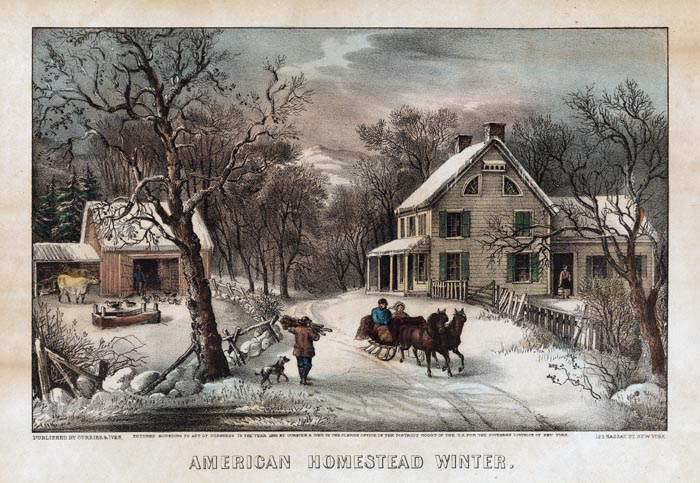
"American Homestead Winter"

"Winter Morning in the Country"
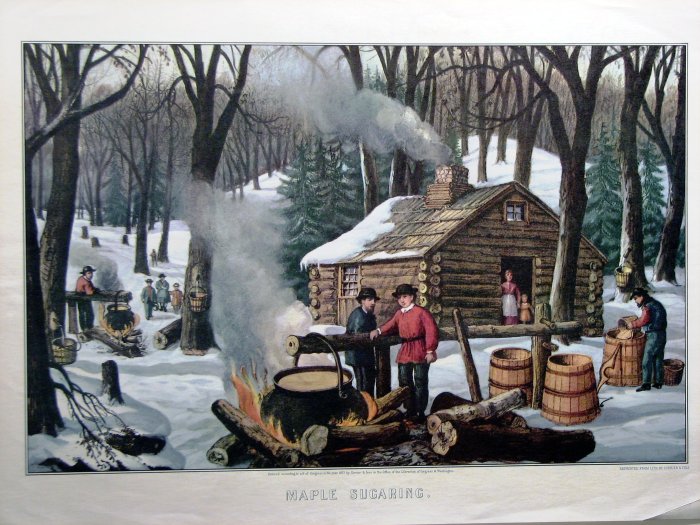
"Maple Sugaring"
I have been postulating that we are headed for a Currier and Ives future - colder winters with a lot more snow - because of the cycle of low solar activity that is just beginning. I've been watching for anecdotal evidence that this is true, and I've seen quite a bit for the last couple of years. This year, a lake I've only ever seen slightly frozen in the last 40 years was frozen hard enough to walk on (or ice-skate) after the recent early-January cold snap. The second half of January has been much more average or typical (here in NC anyway) but the Farmer's Almanac (my new best friend) is predicting a snowy February.
Maybe it will be time to bust out the sleigh that has been collecting dust in the back of the barn for 100 years!
Wednesday, January 6, 2010
A new Maunder Minimum?
The Maunder Minimum was a period of anomalously low solar activity that occurred between 1645 and 1715. It corresponded to the coldest part of the "Little Ice Age", which occurred between approximately 1400 and 1850.
During the Little Ice Age, and particularly the Maunder Minimum, the earth was substantially colder than it is today. Glaciation increased markedly, winters were historically harsh, and major ocean areas and seas froze over.
There is some debate (mainly from the Global Warming crowd) about whether there is a correlation between solar activity and climate, but in the case of the Maunder Minimum, it would be one hell of a coincidence.
The Little Ice Age followed the Medieval Warm Period, during which temperatures were substantially warmer than they are today. Unlike the Maunder Minimum, we do not have great observational data on solar activity during the Medieval Warm Period, although studies of solar activity cycles suggest it was much higher than during the subsequent cold period.
The Medieval Warm Period was famous for its disappearance from IPCC data after the advent of the Global Warming craze:

Data now shows that global warming ceased about 10 years ago and global cooling is accelerating, corresponding almost perfectly with the end of a period of very high solar activity. Here's another fun graphic:

Could this theory (that drastically diminished solar activity has ended global warming and is responsible for abrupt global cooling since 2007) be wrong? Could we still be experiencing global warming despite all evidence to the contrary? I'm still looking for science supporting global warming that still holds up.
Although I understand it is in no way scientific, I'm very much fascinated by anecdotal evidence. There are great descriptions about how warm it was during the Medieval Warm Period (descriptions of Scandinavian settlements in Greenland sounded like they were in Central Europe) and the Little Ice Age (ports that have been ice-free since the beginning of the 20th century (like New York) were completely closed by ice for entire winters). I love the old illustrations of life in the 19th century, showing routine travel by sleigh in the mid-Atlantic states, ice skating on lakes that haven't frozen at all in my lifetime, etc.
I certainly noted apparent warming in the 1970s, 80s, and 90s. Years went by with no snow in many places that previously had lots of it. The tropical ocean was nearly 10 degrees warmer in the winter months than it is now.
But in the last 7-8 years I've noticed cooler weather, with a dramatic drop in the last 2. I used to live in the tropics and for years would scuba dive during the winter in a thin wetsuit. The ocean temperature would bottom out in the low 70s in January, then rise steadily. Since 2006 the temps have dropped steadily and are now around 65. (This is based on NOAA automated observations at Key West). My swimming pool in North Carolina was apparently 10 degrees cooler for most of the summer of 2009 than it was in 2008.
In Washington DC there has been more snow by the end of December 2009 than I have ever seen (possibly since 1969, but I was pretty young then so I'm not sure). The ski areas on the east coast have more snow by the end of December 2009 than they did at any point in the winter throughout the 1980s and 1990s. There were many years where there was almost no snow on the ski areas in North Carolina - at one point we thought they might go out of business. This year they already had more snow base by late December than they did by late February last year - and last year was the best I had seen since perhaps the 1970s.
Although this is all anecdotal, these anecdotes seem to be repeated around the world. 2008 was the coldest winter in China in 100 years. Britain expects 2009 to the the coldest winter in 100 years.
I have an increasingly strong feeling that it will be cold and getting colder for at least the next generation and in a very few years "Global Warming" will be one of the biggest jokes of our lifetimes.
During the Little Ice Age, and particularly the Maunder Minimum, the earth was substantially colder than it is today. Glaciation increased markedly, winters were historically harsh, and major ocean areas and seas froze over.
There is some debate (mainly from the Global Warming crowd) about whether there is a correlation between solar activity and climate, but in the case of the Maunder Minimum, it would be one hell of a coincidence.
The Little Ice Age followed the Medieval Warm Period, during which temperatures were substantially warmer than they are today. Unlike the Maunder Minimum, we do not have great observational data on solar activity during the Medieval Warm Period, although studies of solar activity cycles suggest it was much higher than during the subsequent cold period.
The Medieval Warm Period was famous for its disappearance from IPCC data after the advent of the Global Warming craze:

Data now shows that global warming ceased about 10 years ago and global cooling is accelerating, corresponding almost perfectly with the end of a period of very high solar activity. Here's another fun graphic:

Could this theory (that drastically diminished solar activity has ended global warming and is responsible for abrupt global cooling since 2007) be wrong? Could we still be experiencing global warming despite all evidence to the contrary? I'm still looking for science supporting global warming that still holds up.
Although I understand it is in no way scientific, I'm very much fascinated by anecdotal evidence. There are great descriptions about how warm it was during the Medieval Warm Period (descriptions of Scandinavian settlements in Greenland sounded like they were in Central Europe) and the Little Ice Age (ports that have been ice-free since the beginning of the 20th century (like New York) were completely closed by ice for entire winters). I love the old illustrations of life in the 19th century, showing routine travel by sleigh in the mid-Atlantic states, ice skating on lakes that haven't frozen at all in my lifetime, etc.
I certainly noted apparent warming in the 1970s, 80s, and 90s. Years went by with no snow in many places that previously had lots of it. The tropical ocean was nearly 10 degrees warmer in the winter months than it is now.
But in the last 7-8 years I've noticed cooler weather, with a dramatic drop in the last 2. I used to live in the tropics and for years would scuba dive during the winter in a thin wetsuit. The ocean temperature would bottom out in the low 70s in January, then rise steadily. Since 2006 the temps have dropped steadily and are now around 65. (This is based on NOAA automated observations at Key West). My swimming pool in North Carolina was apparently 10 degrees cooler for most of the summer of 2009 than it was in 2008.
In Washington DC there has been more snow by the end of December 2009 than I have ever seen (possibly since 1969, but I was pretty young then so I'm not sure). The ski areas on the east coast have more snow by the end of December 2009 than they did at any point in the winter throughout the 1980s and 1990s. There were many years where there was almost no snow on the ski areas in North Carolina - at one point we thought they might go out of business. This year they already had more snow base by late December than they did by late February last year - and last year was the best I had seen since perhaps the 1970s.
Although this is all anecdotal, these anecdotes seem to be repeated around the world. 2008 was the coldest winter in China in 100 years. Britain expects 2009 to the the coldest winter in 100 years.
I have an increasingly strong feeling that it will be cold and getting colder for at least the next generation and in a very few years "Global Warming" will be one of the biggest jokes of our lifetimes.
Tuesday, December 1, 2009
An example
Somebody who gets it - Bob Baer on Iraq:
BAER: Yes. (U.S. Ambassador to Iraq) Ryan Crocker said it was the Iranians blocking a basing agreement. It was the Iranians buying elections and buying up the parliament. That tells me that Iran has de facto control over the country. Crocker didn’t say it was just a question of bringing a few parliamentarians around; he said Iran. That was his official statement. Crocker was the ambassador to Lebanon at the time I was there, and he calls this Iraq’s “Lebanonization.” Observers use Serbia as an example for Iraq and say we accomplished a victory there with just American troops. But they did it there with the Sunnis and Shi'a together. They were complicit in lowering the level of violence. Iran could make life hell if they unleash the Shi’a on us, as they’ve already done in the south of Iraq. The Iranians could fight us forever in Iraq, but that doesn’t actually serve their immediate interests. They know to just remain patient because eventually the Americans will leave. I don’t care if we even reach a basing agreement. Iran will undermine it. Unless we’re committed to placing a million troops in the region to contain this empire—as we did the Soviet empire—the basing agreement simply won’t have an effect.
Subscribe to:
Posts (Atom)

